What we measure, and how.
Maintainability Cloud is the code-measurement layer of Claroview’s Software Insights Platform. It reads every repository, scores it on a calibrated model benchmarked against 2,700 open-source systems, and tracks the result week after week. This page is the specification; the services are where it becomes a decision.
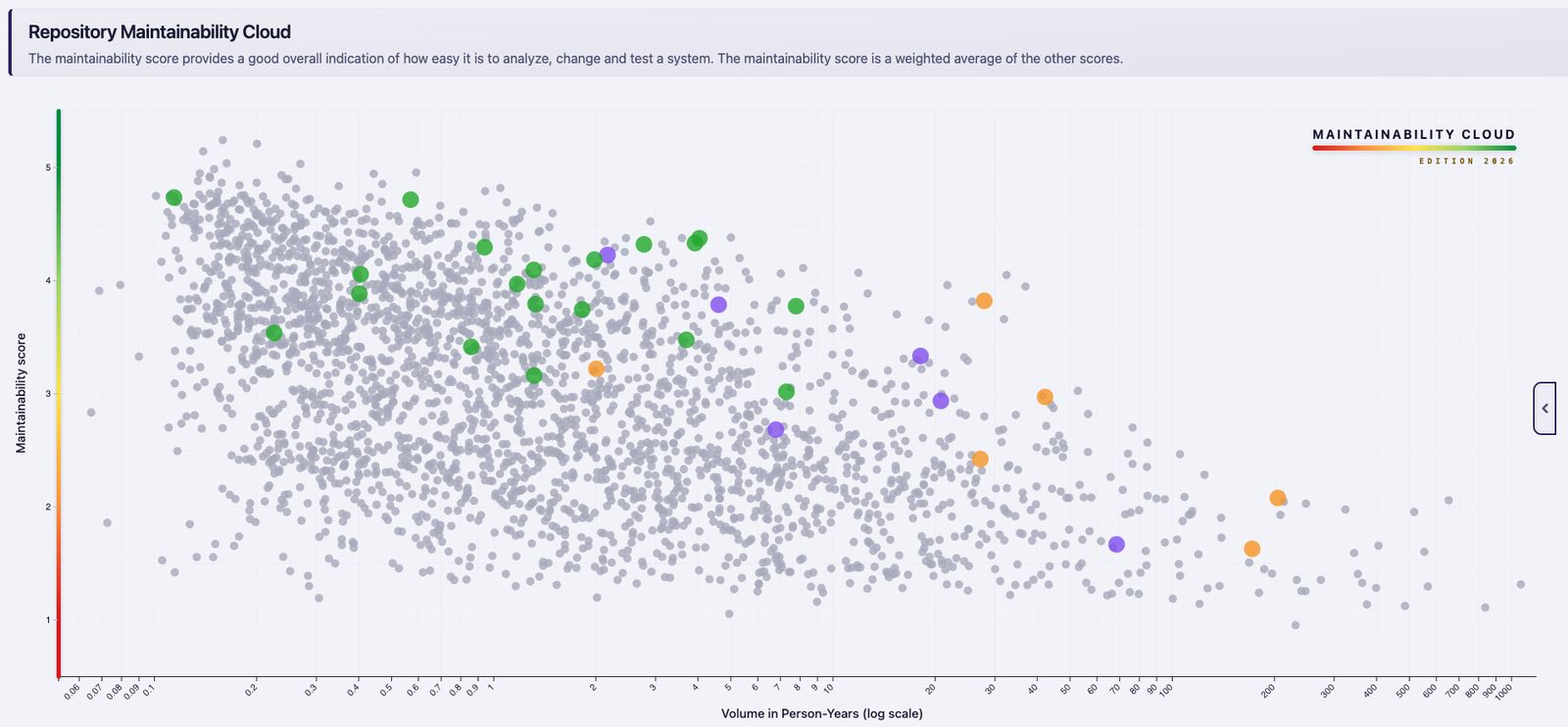
One benchmarked scale, every repository
Every measure is produced for every repository in scope, on the same scale, so systems compare like for like whoever wrote them.
- Maintainability
- A score from 1 to 5 for the characteristic as ISO/IEC 25010:2023 defines it (one of nine product-quality characteristics), aggregated from the properties below with calibrated weights and benchmarked against real-world systems.
- Volume and growth
- The size of each codebase in person-years of engineering effort, research-backed and comparable across more than fifty languages, and its growth over time. Growth reported next to quality is what makes a fast-growing, flat-quality codebase visible.
- Properties
- Duplication, unit size, unit complexity, file size and test ratio: the code-level properties that determine how easy a system is to analyse, change and test.
- Risk exposure
- Dependency vulnerabilities, secrets in git history, open-source licence obligations and an SBOM per repository, read alongside quality rather than in a separate tool.
- Architecture
- The dependencies, boundaries and layering as implemented in the code, set against the intended architecture and tracked as the gap moves. Typically needs expert configuration; not every technology is supported.
- History and people
- File age and change frequency, and contributor patterns that show where critical systems depend on a single individual.
Feature availability depends, among other things, on the technologies used and the client’s data-sharing policy.
A score is a position among recognised peers
2,700 open-source systems
The calibrated benchmark includes systems from Google, Apache, Amazon, Spotify, Mozilla and Netflix, measured on the same instrument as your code.
8,400 person-years
The engineering effort in the reference set, maintained and re-calibrated over time so the scale stays honest as the industry moves.
50+ languages
One measurement model, comparable across languages and technology stacks, so a polyglot portfolio still reads on one scale.
Weekly, for years
Every repository is measured every week, and the history is kept, so a score becomes a direction of travel and improvement can be proven against the baseline.
Open standards, proprietary calibration
- Analysis
- Built on the open-source Sokrates analysis engine, with further engines plugged in for security, licences and SBOM. The scoring models on top are Claroview’s own, calibrated against the benchmark.
- Standards
- Maintainability is measured as ISO/IEC 25010:2023 defines it, the current edition of the standard (it replaced ISO/IEC 25010:2011). The standard defines what quality is; the benchmark is how we measure it.
- Languages
- Java, C#, JavaScript, TypeScript, Python, Go and many more. Where a technology is not supported, we say so in scoping.
- Delivery models
- Cloud analysis: Claroview reads the repositories and runs everything. Local analysis: the analysis runs in your environment and only the results reach the platform. Report upload: the source never leaves. Each step away from cloud analysis narrows what the platform can see, and we say so up front.
- Access
- Read-only repository access, single sign-on for your people, nothing to install or operate.
Where the measurement becomes a decision
- Software Portfolio Assurance
- Weekly measurement of every repository in a portfolio, with the review rhythm that turns it into decisions. Also for a single application as Application Monitoring.
- Software Risk Assessment
- A one-off, benchmarked deep analysis for due diligence, vendor assessment, AI readiness or strategic planning.
- AI Readiness Scan
- One system in its environment, measured in seven dimensions against what it needs. The Code dimension of the AI Readiness Maturity Model builds on the maintainability rating.
- Enterprise Architecture Measurement
- Model quality and the drift between intended and implemented architecture, for the readiness question.
- SharePoint Repository Analysis
- The structure of your digital workspace, made visible and measurable.